
Address validation software for clean, usable address data worldwide
Wrong postcodes, missing house numbers and the same street typed three different ways end up in your CRM, your ERP and your shipping labels. Each one costs something later: a failed delivery, a duplicate customer record, a technician sent to the wrong door. EGON checks every address against reference data for over 250 countries, corrects what it can, completes what is missing and returns it in a standard format your systems can match and reuse.
You can validate addresses as they are typed, clean an entire database in batch, or call EGON from your own applications through the API.
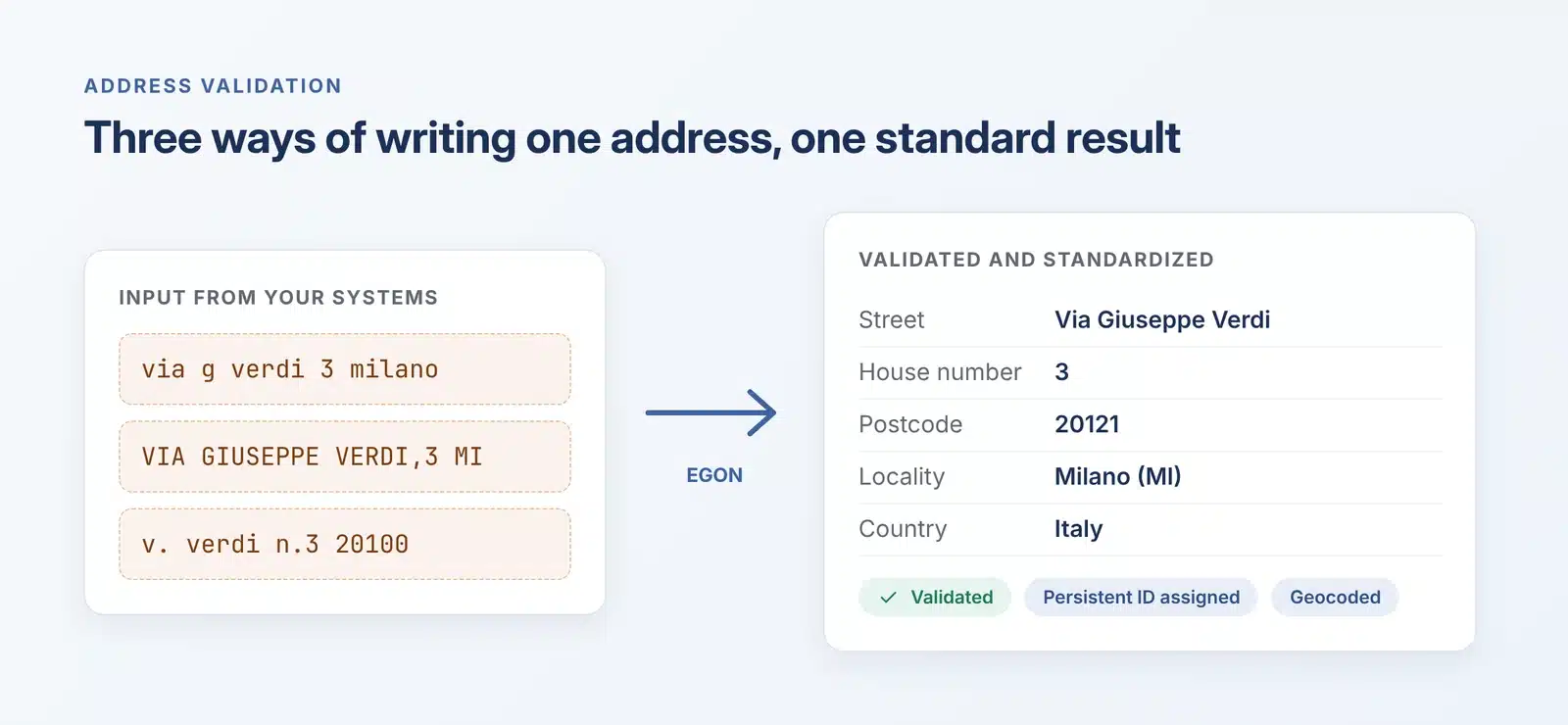
What EGON address validation does
Address validation is more than checking that a street exists. For each address, EGON:
- splits free text into separate fields (street, house number, postcode, locality, region, country), even when everything arrives in one line;
- corrects spelling errors, abbreviations and outdated street names;
- adds missing elements such as the postcode or the province;
- formats the result according to the postal conventions of the destination country;
- flags the addresses it cannot confirm, so they are reviewed instead of silently accepted;
- adds geographic coordinates on request, down to house number level where the country’s data allows it (see address geocoding).
Coverage depth varies by country. In some countries validation reaches the house number, in others it stops at street or locality level. The country pages show the level available for each service.
Four ways to use address validation
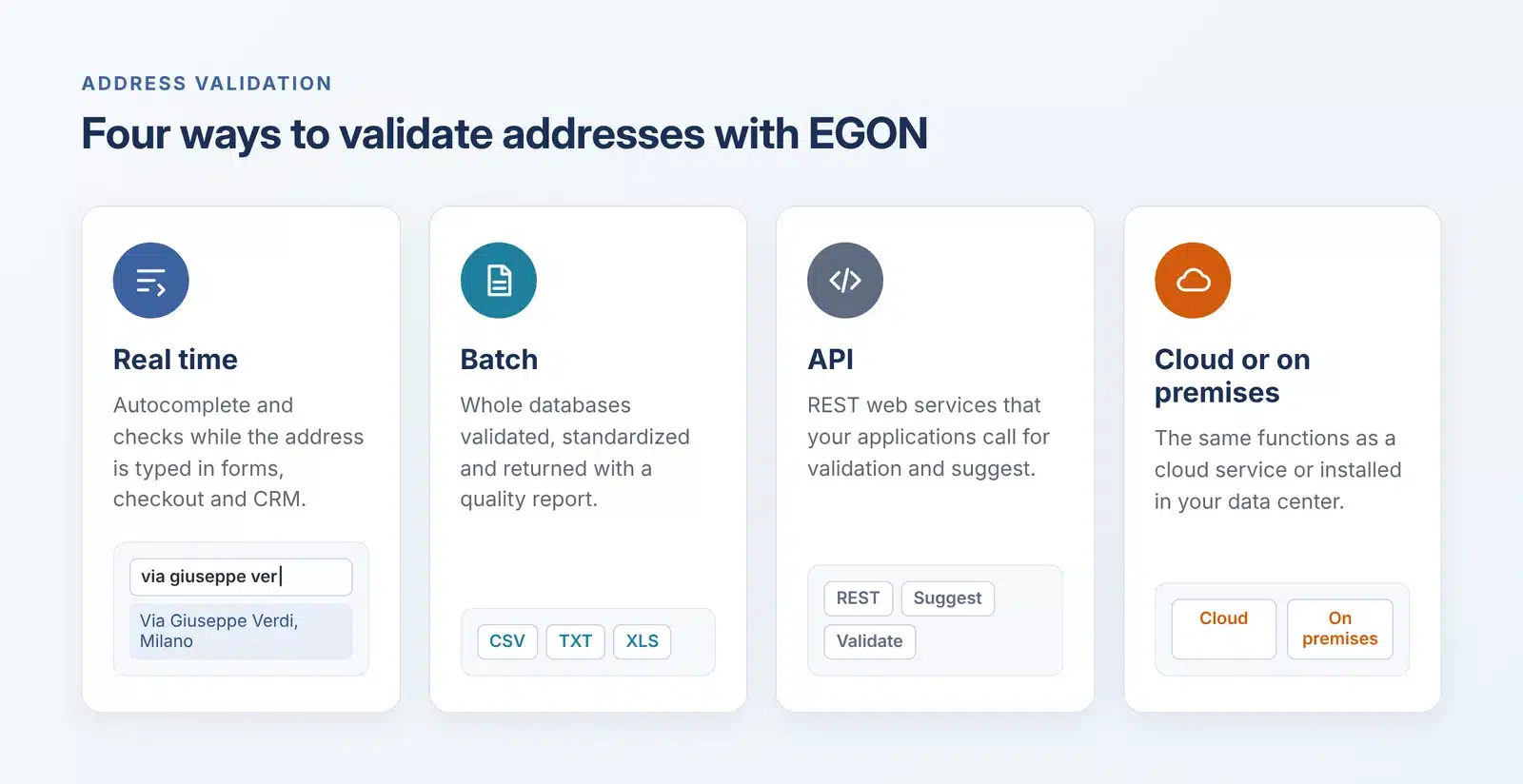
In real time, while data is entered
In web forms, checkout pages and CRM screens, autocomplete suggests the right address as the user types, and validation checks it before it is saved. Errors are stopped where they are cheapest to fix: at the source. See online address validation.
In batch, for existing databases
Send a structured file (CSV, TXT, XLS and other formats) and get it back validated and standardized, with a statistical report on the quality of the original data. On request, the same run can deduplicate and geocode the records. Batch cleansing is the usual starting point before a CRM migration, a merge of two systems or a large mailing. See batch address validation.
Through the API and web services
A REST API lets your applications call the validation and suggest functions directly. The API documentation is public, so your developers can assess the integration before talking to us.
In the cloud or on premises
EGON runs as a cloud service, with a separate dedicated environment for enterprise customers, or it can be installed in your data center when address data cannot leave your infrastructure. The functions are the same in both setups, and EGON integrates with ERP and CRM platforms and with environments such as SAP and Oracle.
A persistent identifier for every recognized address
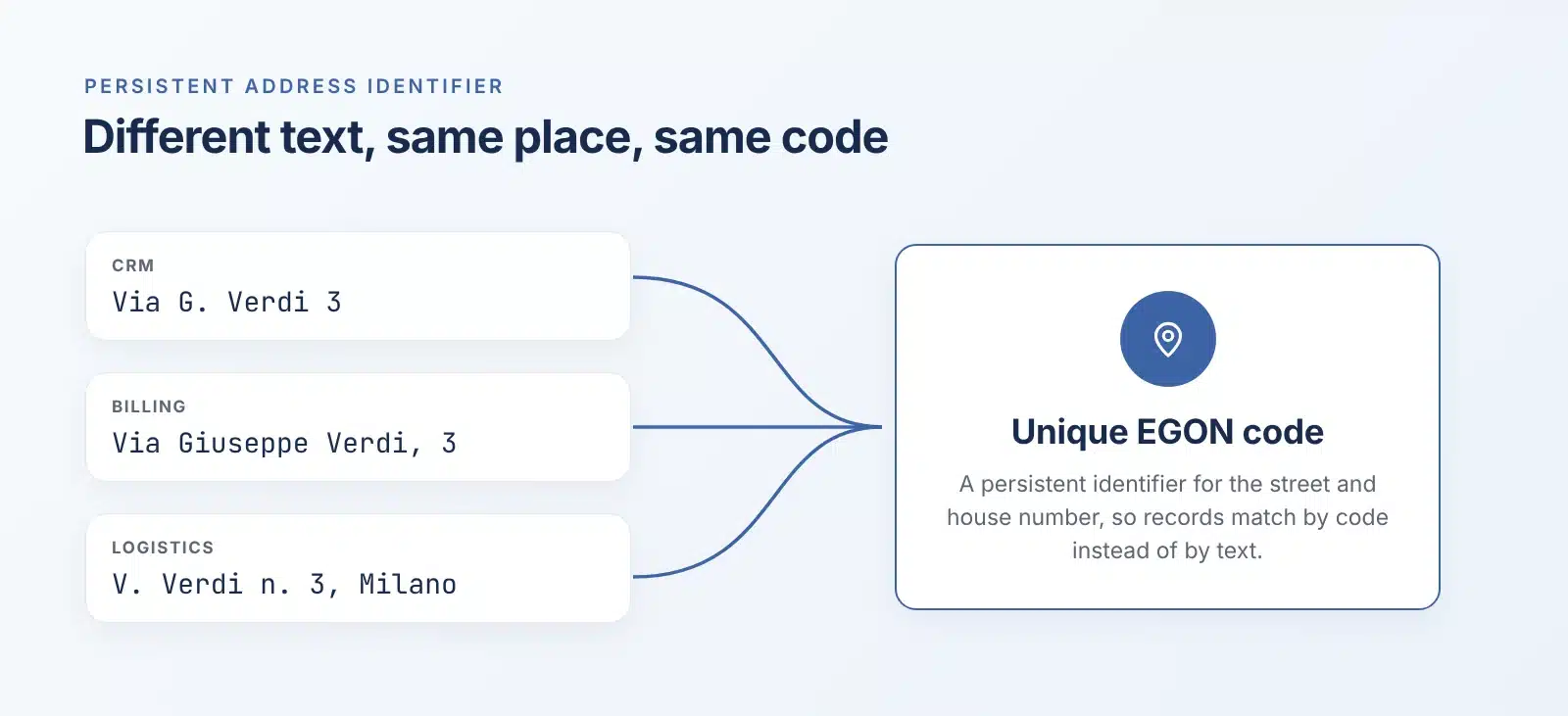
When EGON recognizes an address in its reference database, it can assign a persistent identifier to the street and the house number. EGON calls it the EGON code. Two records that describe the same place in different ways, such as “Via G. Verdi 3” and “Via Giuseppe Verdi, 3”, receive the same code. Matching records across databases and finding duplicate addresses then becomes a comparison of codes rather than of text strings.
When automation is not enough
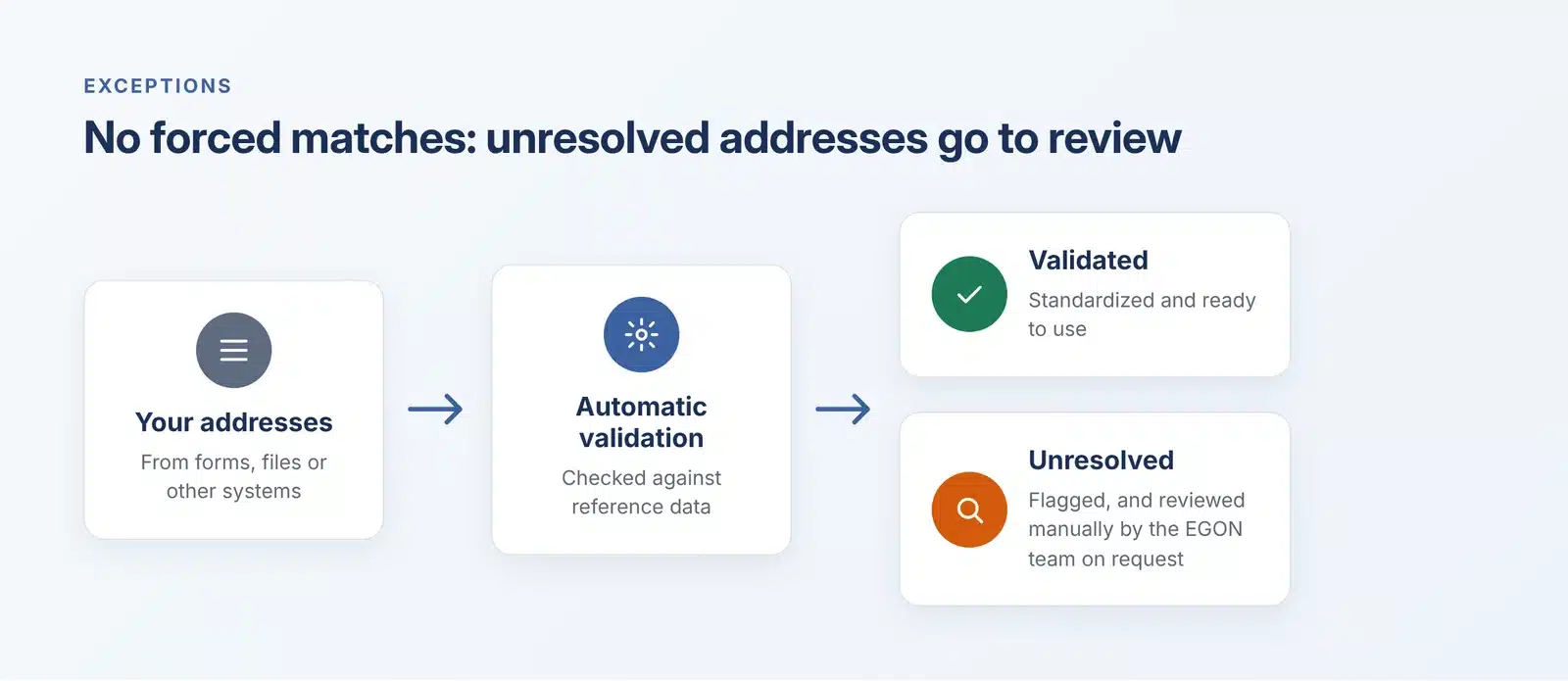
Some addresses cannot be resolved automatically: rural locations without a street name, new buildings not yet in reference data, local numbering systems. EGON does not force a match. It returns these addresses as unresolved, and as an additional service the EGON team can review and correct them manually.
Where address validation makes a difference
- Logistics and e-commerce: fewer failed deliveries and returns caused by incomplete or wrong addresses.
- Telecom and energy: one consistent address for each installation or supply point across network, sales and billing systems.
- Banking and insurance: the same customer address in every product and channel.
- Public administration: standardized addresses for citizens, companies and public bodies.
- Data migration: addresses cleaned before they move to a new CRM or ERP, not after.
Who relies on EGON
EGON has worked on address data for over 30 years. Some of its uses are documented in public sources:
- Open Fiber’s coverage database includes EGON street and house number identifiers.
- Consip documents EGON as the software that normalizes and geolocates addresses for Agenzia delle Entrate-Riscossione, Italy’s tax collection agency, and as a component of the master data system of the State General Accounting Department.
- ISTAT, the Italian National Institute of Statistics, licensed EGON Point Addressing for 2026 and 2027.
EGON is certified to ISO/IEC 27001, 27017 and 27018 for information security and the protection of data in the cloud.
All trademarks and logos are the property of their respective owners.
Frequently asked questions about address validation
What is the difference between address validation and address verification?
The two terms are often used interchangeably. Both check an address against reference data, correct it and complete it. Neither proves that a specific person lives at that address: that is identity verification, a different process.
How many countries does EGON cover?
Over 250 countries. The level of detail depends on the reference data available in each country, so check the country pages or ask us about the countries that matter to you.
Can I test EGON on my own data?
Yes. The free account gives you 100 credits, enough to validate up to 100 addresses. No credit card is required, and you have 30 days to use them. For a larger test sample, contact us.
How is EGON priced?
For smaller volumes, EGON works with prepaid credits. Enterprise customers work on a separate dedicated cloud environment, with no time or credit limits. On-premises installations are also available. For enterprise pricing, contact us.
Does address validation make my data GDPR compliant?
The GDPR requires personal data to be accurate, and validation helps keep addresses accurate and up to date. Compliance, however, depends on how your organization collects and manages data as a whole.
Start with a sample of your own addresses
The quickest way to judge address validation is to run it on your data. Create a free account with 100 credits, enough for up to 100 addresses, and test real time and batch validation on real records. If you are an enterprise, manage large volumes or need an on-premises installation, write to info@egondataquality.com: an address data specialist will help you plan the test and find the right plan for your volumes.
