
Personal data validation for names, phone numbers, emails and tax codes
A customer record is more than an address. Names typed in capitals or split across the wrong fields, phone numbers without a prefix, emails with a misspelt domain, an Italian tax code that does not match the date of birth: each error breaks a mailing, a call, an invoice or a check later on. EGON validates and standardizes the personal and company data in each record, flags what does not add up and returns it in a consistent format, alongside the validated address.
You can validate data as it is entered, clean an entire database in batch, or call EGON from your own applications through the API.
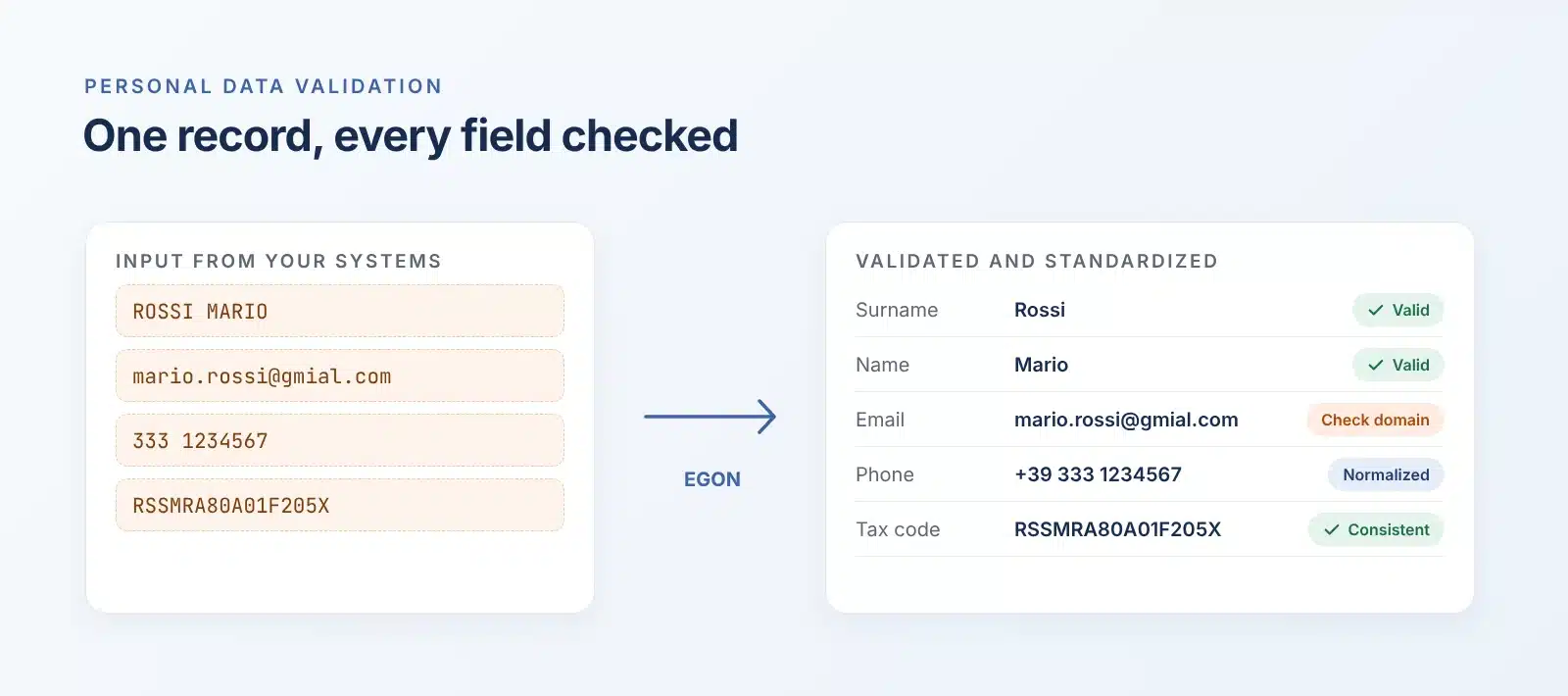
What EGON checks
Alongside address validation, EGON can validate:
- names of people, sole proprietorships and companies, including co-holders and family surnames, returned in separate structured fields;
- email addresses, with a normalized value and indicators on the syntax and the domain;
- phone numbers, normalized whether the international prefix arrives in a separate field or inside the number;
- Italian tax codes (codice fiscale): formal validity, calculation from the personal details, extraction of gender, date and place of birth, and comparison with the personal details on the record;
- Italian VAT numbers (partita IVA): formal validity and, on request, enrichment with the business name, registered address, phone numbers, certified email (PEC) and ATECO activity codes.
Each result comes with a quality code, so your process knows which values were confirmed, which were corrected and which need attention.
Consistent data across fields
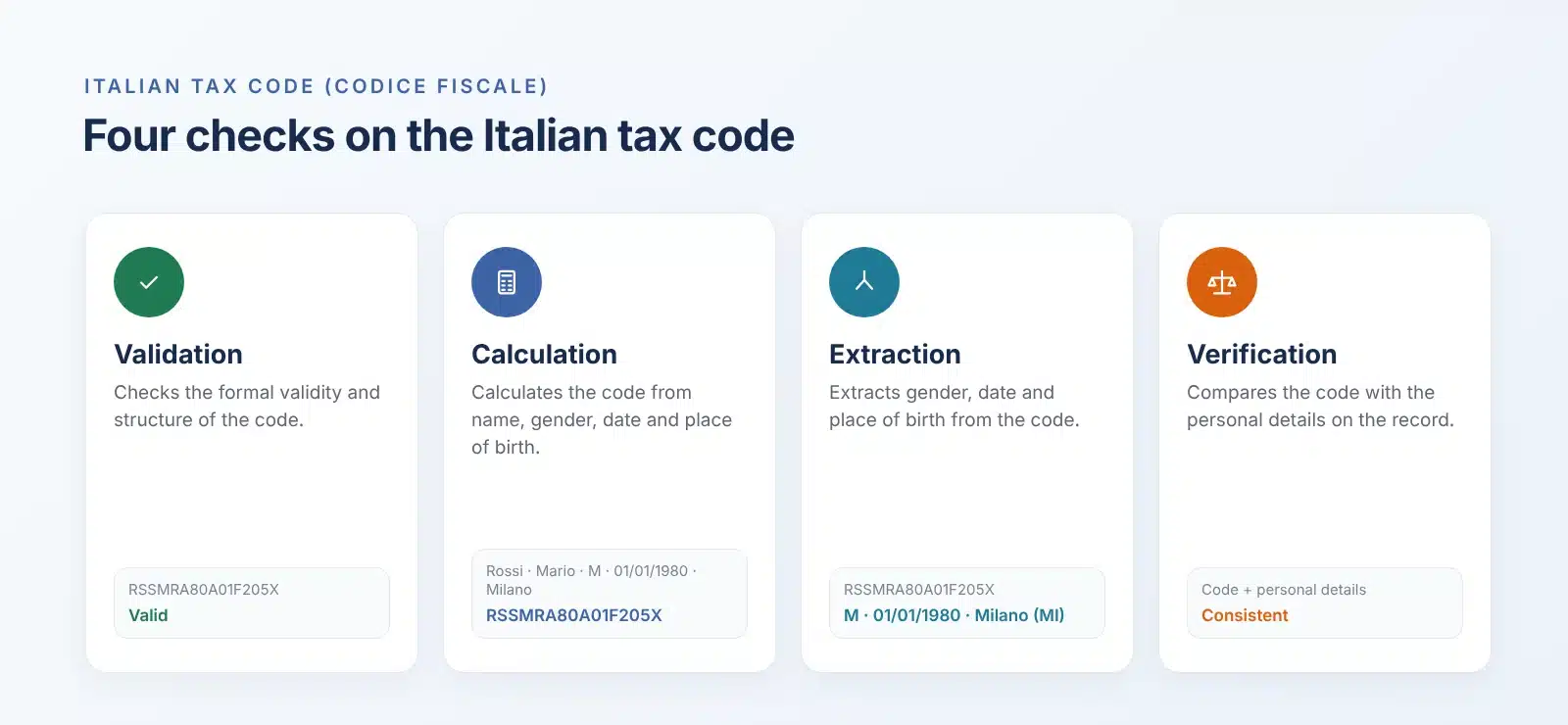
Many errors in personal data are not in a single field but between fields: a tax code that belongs to someone born in another year, or a company name typed where a surname should be. Besides checking each field, EGON can compare fields with each other, for example the tax code with the name, gender, date and place of birth on the same record. Records that pass are consistent and ready to be used by billing, CRM and communication systems; the others are flagged for correction.
What personal data validation does not do
Validation checks that data is formally correct and consistent. It does not prove who a person is: a valid tax code, a working email domain or a well-formed phone number do not confirm that the record belongs to the person who submitted it. That is identity verification, a different process that relies on documents and dedicated checks.
Three ways to use personal data validation
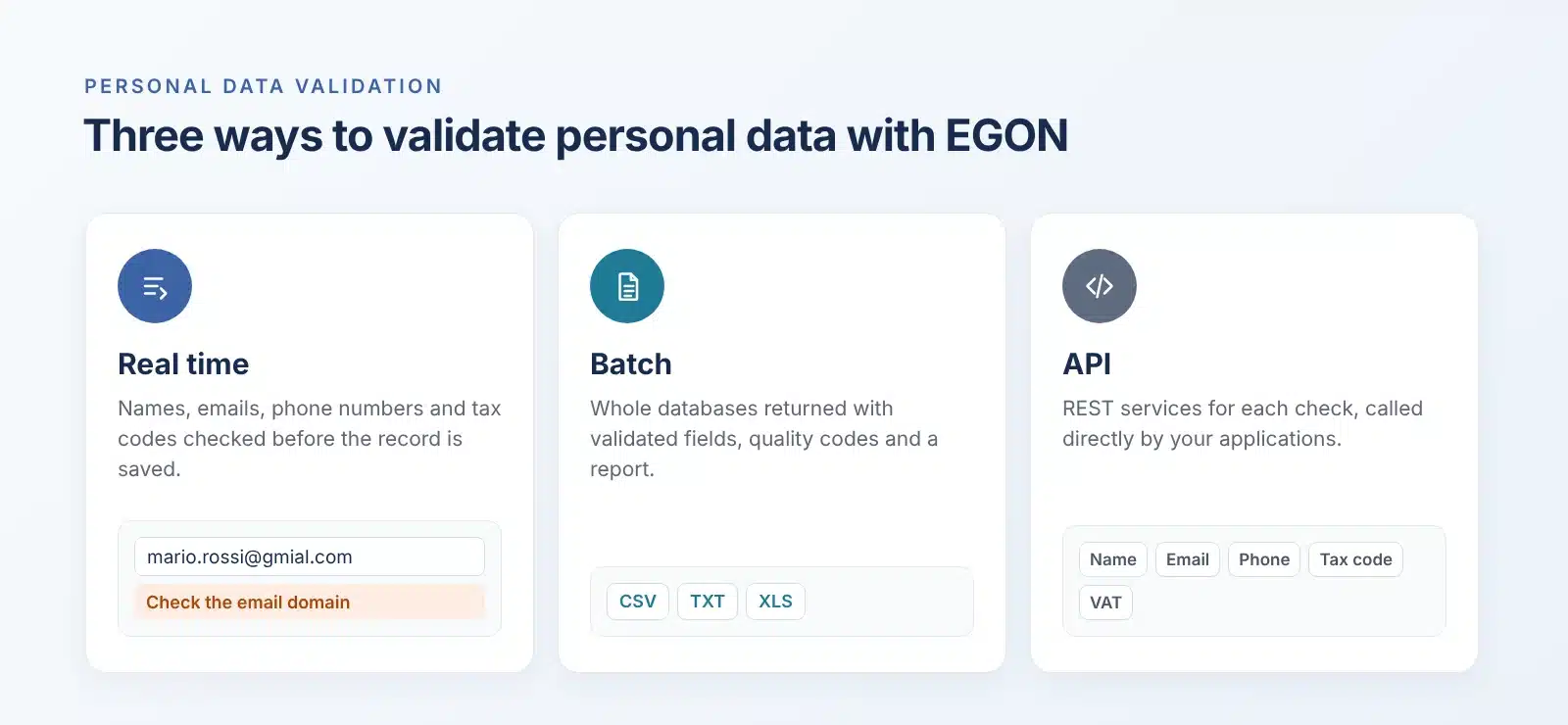
In real time, while data is entered
In registration forms, checkout pages and CRM screens, names, emails, phone numbers and tax codes are checked before the record is saved, so errors are fixed while the customer is still there. See online address validation.
In batch, for existing databases
Send a structured file (CSV, TXT, XLS and other formats) and get it back with validated and standardized fields, quality codes and a statistical report. On request, the same run can deduplicate the records. See batch address validation.
Through the API and web services
A REST API exposes each validation service separately: name, email, phone, tax code and VAT number. The API documentation is public, so your developers can assess the integration before talking to us.
Where personal data validation makes a difference
- Banking and insurance: complete and consistent customer data before contracts, statements and regulatory reporting.
- Telecom and energy: contract holders, contact details and tax codes checked at activation.
- E-commerce and retail: registrations with reachable emails and phone numbers.
- Public administration: registries of citizens and companies with valid tax codes and VAT numbers.
- CRM and data migration: personal data standardized before moving to a new system.
Who relies on EGON
EGON has worked on address data for over 30 years. Some of its uses are documented in public sources:
- Open Fiber’s coverage database includes EGON street and house number identifiers.
- Consip documents EGON as the software that normalizes and geolocates addresses for Agenzia delle Entrate-Riscossione, Italy’s tax collection agency, and as a component of the master data system of the State General Accounting Department.
- ISTAT, the Italian National Institute of Statistics, licensed EGON Point Addressing for 2026 and 2027.
EGON is certified to ISO/IEC 27001, 27017 and 27018 for information security and the protection of data in the cloud.
All trademarks and logos are the property of their respective owners.
Frequently asked questions about personal data validation
Is personal data validation the same as identity verification?
No. EGON checks that names, emails, phone numbers and tax codes are formally correct and consistent with each other. It does not confirm that a person is who they say they are.
Do the tax code and VAT checks work outside Italy?
The tax code and VAT services described here are designed for Italian codice fiscale and partita IVA. Name, email and phone validation are not limited to Italy; ask us about the countries that matter to you.
Does validation make my data GDPR compliant?
The GDPR requires personal data to be accurate, and validation helps keep it accurate and up to date. Compliance, however, depends on how your organization collects and manages data as a whole.
Can I test EGON on my own data?
Yes. The free account gives you 100 credits to try EGON on your own records. No credit card is required, and you have 30 days to use them. For a larger test sample, contact us.
Start with a sample of your own records
The quickest way to judge personal data validation is to run it on your data and look at the quality codes it returns. Create a free account with 100 credits, or, if you manage large volumes or need an on-premises installation, write to info@egondataquality.com: a data specialist will help you plan the test and find the right plan for your volumes.
